
Criminal Court Cases in Caroline County
Caroline County criminal court cases divide between three local courts. The Caroline Circuit Court, part of the 15th Judicial Circuit, holds felony trials, grand-jury indictments, district appeals, and petitions tied to expungement or sealing. Its clerk is the custodian of the circuit case file. The Caroline General District Court handles misdemeanors, traffic charges, warrants, and felony preliminary hearings. A felony can therefore have entries at both levels. The J&DR District Court handles juvenile and family matters, but those files follow special access rules and do not appear in the public online case system.
The official Circuit Court profile shows the office that maintains Caroline County felony case records. The image below comes from the Virginia Judiciary Circuit Court page.
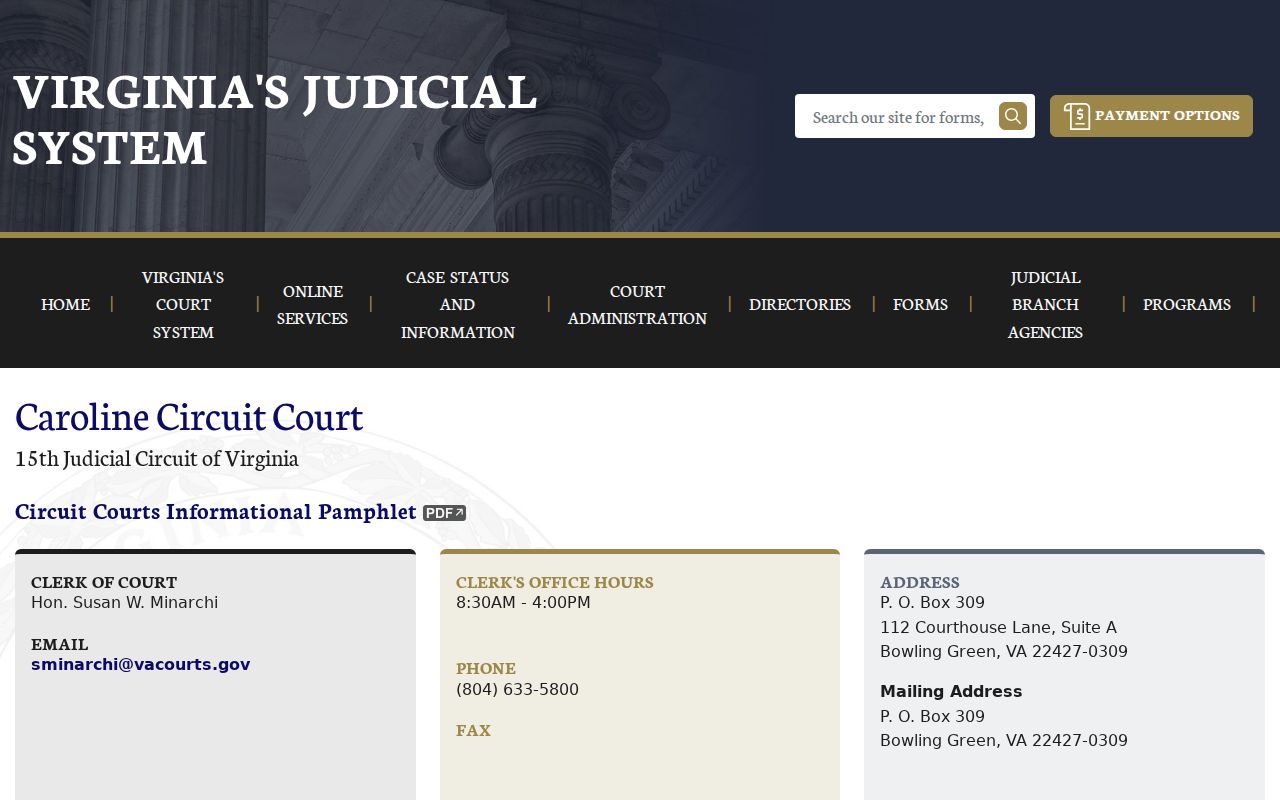
That court page is the best place to confirm current clerk hours and court policies before requesting a signed order or certified judgment.
Caroline County Court Levels
A common Caroline County search error is stopping at the first district entry. General District conducts the felony preliminary hearing, where the court decides whether probable cause supports sending the charge forward. A certified charge or grand-jury true bill proceeds to Circuit Court. The plea, trial, final disposition, and felony sentence then belong in the circuit record. By contrast, most misdemeanors remain in General District unless a party takes an appeal. A de novo appeal creates a new Circuit Court record because the matter is heard again.
The official General District page provides the contact point for misdemeanor records and early felony events. Its source view is shown below from the Caroline General District Court profile.
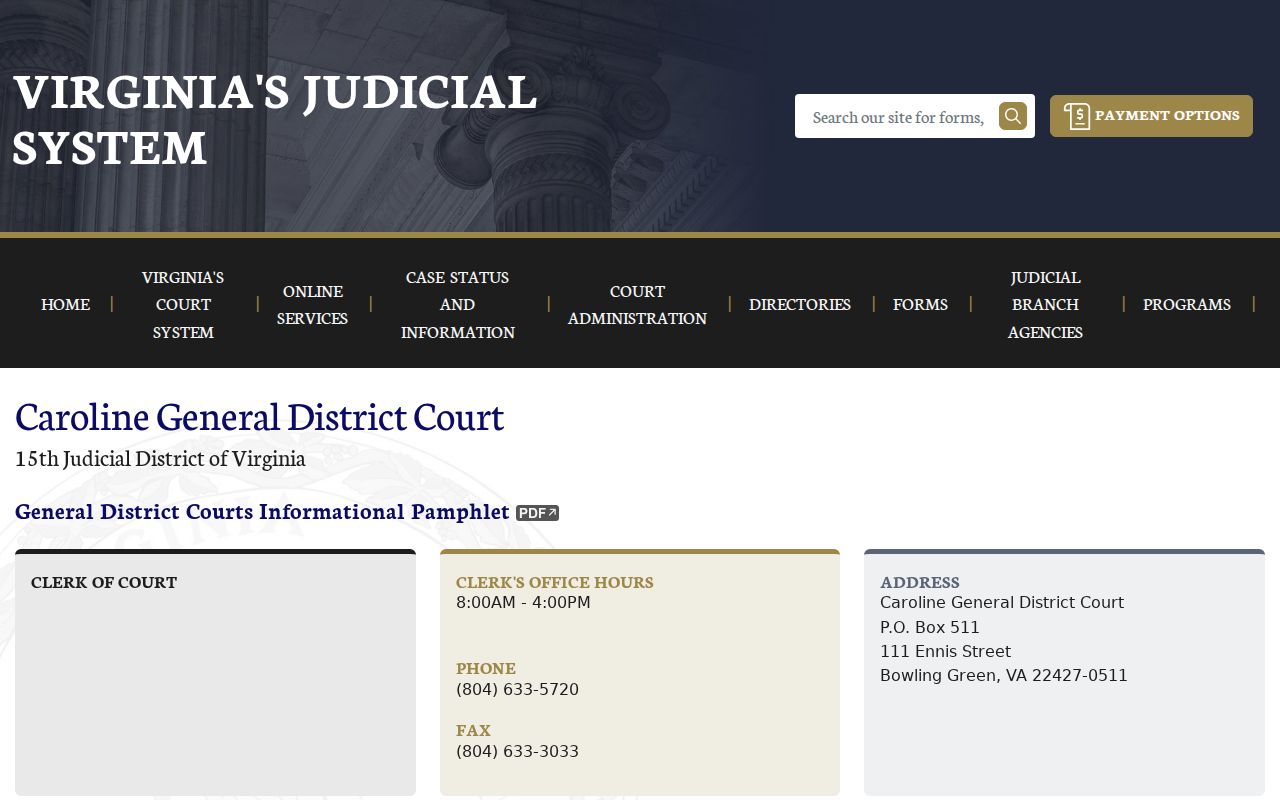
Use the court name printed on the warrant, summons, or search result to avoid asking one clerk for a file held by the other.
Note: A district felony entry may end at certification while the related Caroline County trial record continues in Circuit Court.
Caroline County Case Record Searches
The Virginia Judiciary Online Case Information System is the broadest free starting point for Caroline County court case lookup work. Statewide criminal and traffic coverage includes general district courts and participating circuit courts. Separate court-specific interfaces also remain available. Search results are docket indexes, not a promise that each pleading can be downloaded. Complete these steps before asking a clerk for a copy:
- Open OCIS or the court-specific search and accept the live terms.
- Select Caroline and the correct court when using a locality route.
- Search by exact case number when known, or use the defendant name with care.
- Open the result and record its court, case number, status, hearing date, and disposition.
- Call the proper Caroline County clerk for pleadings, signed orders, or a certified copy.
| Field Label | Type | Required | Notes |
|---|---|---|---|
| Court / Locality | Dropdown | Local route | Select Caroline Circuit or General District. |
| Search statewide | Route or tab | No | Covers criminal and traffic data in participating courts. |
| Name | Text | One search key | Try known spelling variants, then verify identity. |
| Case Number | Text | One search key | The exact identifier yields the narrowest match. |
| Hearing Date | Date | One search key | Useful in the locality docket search. |
| Case Type | Filter | Varies | Criminal, traffic, and civil choices depend on the route. |
The statewide interface itself is documented in the OCIS source captured here.
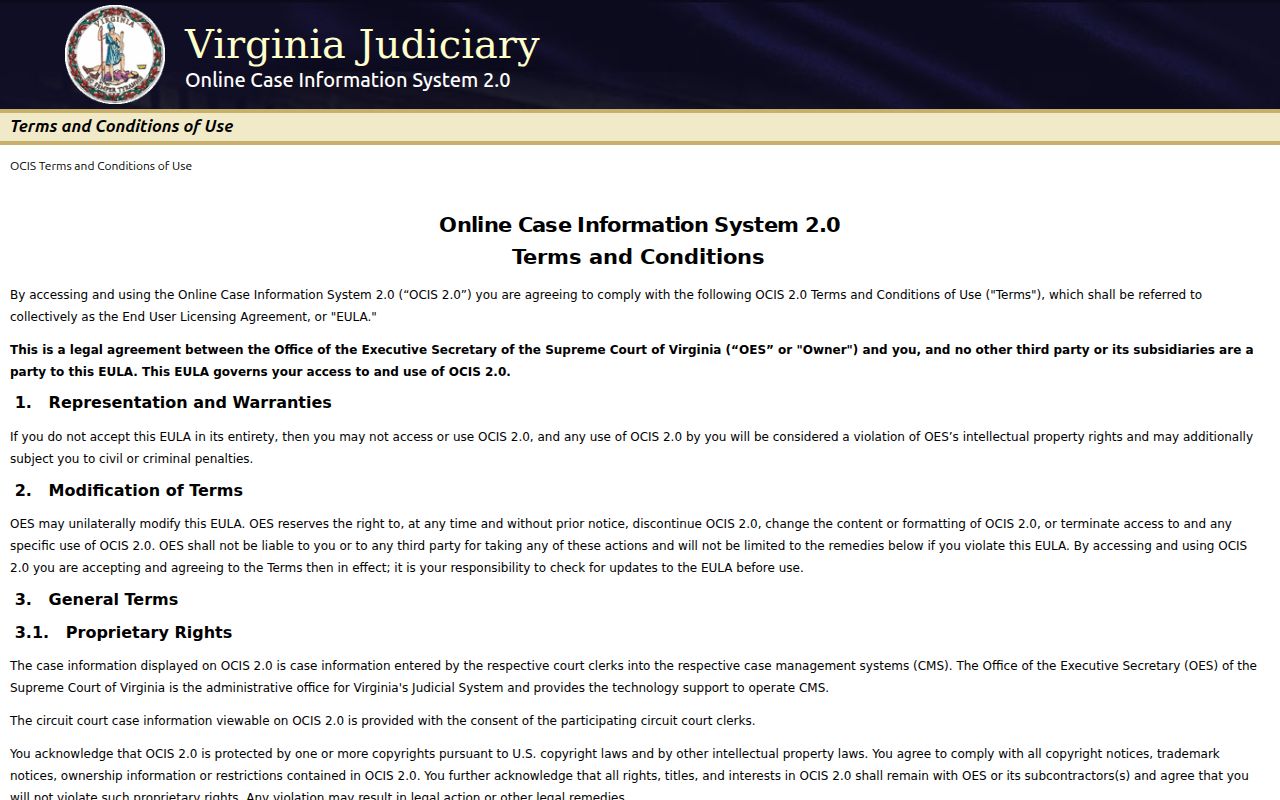
The field layout favors a case number, but a name or hearing date can help when the number is missing.
Caroline County Docket or Order
An OCIS line is useful for finding a Caroline County case, yet it is not the same as a certified court order. The web index can show dates, status, plea, disposition, sentence data, bond details, and financial entries when those fields are available. It may not supply the indictment, exhibits, sentencing order, or every scanned pleading. For those items, contact the clerk that holds the case. Online viewing is free, while the Caroline County criminal-copy fee was not stated in the official sources reviewed. Ask the clerk to confirm plain-copy and certification costs before placing an order.
The Virginia Judiciary explains these limits and routes in its Find a Case guidance.
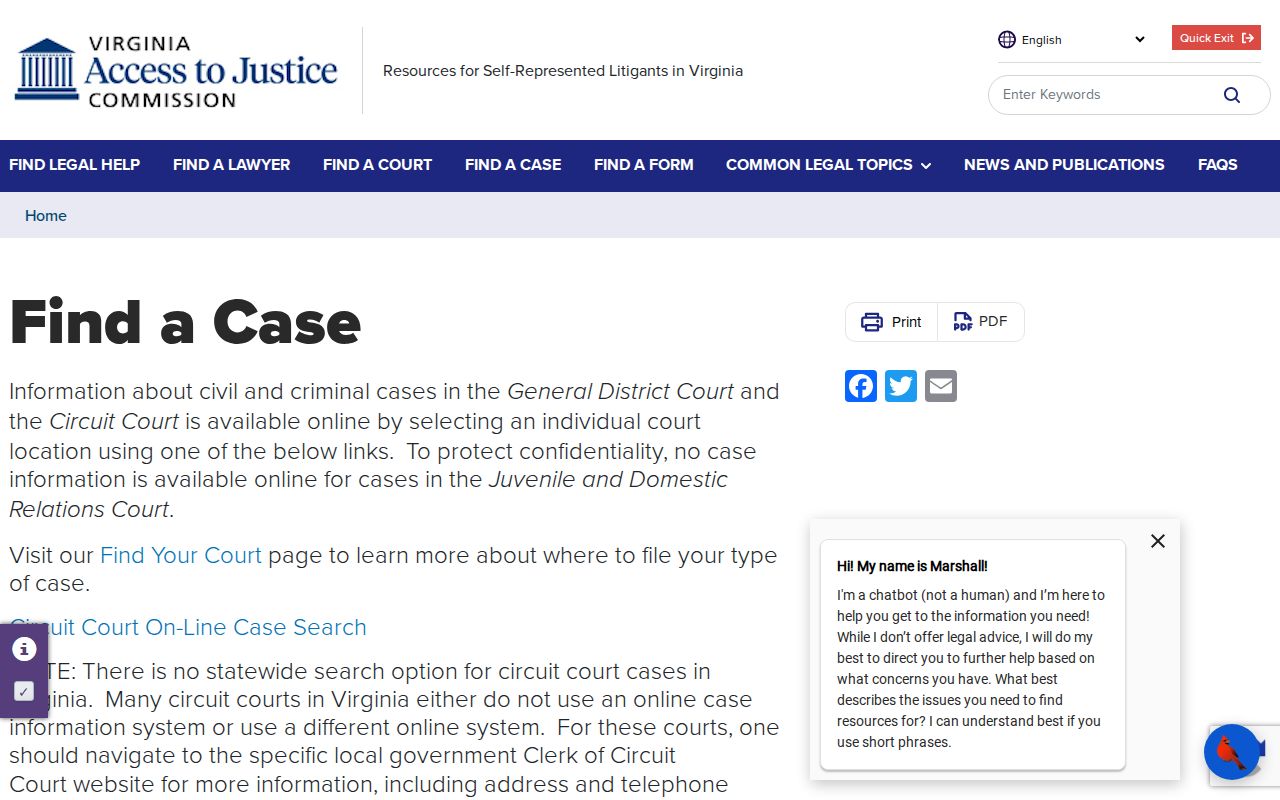
This distinction matters when proof of a disposition is needed: use the index to locate the file, then obtain the signed or certified record from Caroline County.
What a Criminal Case File Contains
A Caroline County criminal case file centers on a court case number and the steps taken by that tribunal. It may contain the charging paper, hearing history, pleas, motions, judicial orders, result, sentence, bond, and money owed. The public index presents selected fields rather than the whole paper or scanned file. Read each charge separately because one case can contain more than one count, and each count can end in a different result.
| Case Number & Court | The unique file reference and Caroline County court that owns the docket. |
|---|---|
| Charge | Offense wording, statute or Virginia Crime Code, and changes made after filing. |
| Docket Events | Arraignments, motions, continuances, hearings, trial, and other dated entries. |
| Plea & Disposition | The formal response and the result for each charge, with dates when shown. |
| Bond | Release terms and related case entries, not a current warrant guarantee. |
| Sentence | Jail term, suspended time, probation, fines, costs, and other ordered terms. |
A dismissal, acquittal, or nolle prosequi is not a conviction. Likewise, an arrest date in the file does not prove that the arrest wording remained the filed or final charge.
Older Caroline County Court Files
The current Caroline County courthouse dates to 1835. That long recordkeeping history means an older criminal matter may be on paper, in an archive, or absent from a modern web index. If OCIS returns nothing, call the Circuit Clerk at 804-633-5800 or the General District clerk at 804-633-5720. Give the court level, name as it appeared then, approximate year, and any case number. Ask whether the material is on site, scanned, archived, or available only through a copy request.
The J&DR court presents a separate problem. Juvenile and family-related case information is restricted and is not public online. The official Caroline J&DR Court page identifies the court contact but does not turn a confidential file into a public record.
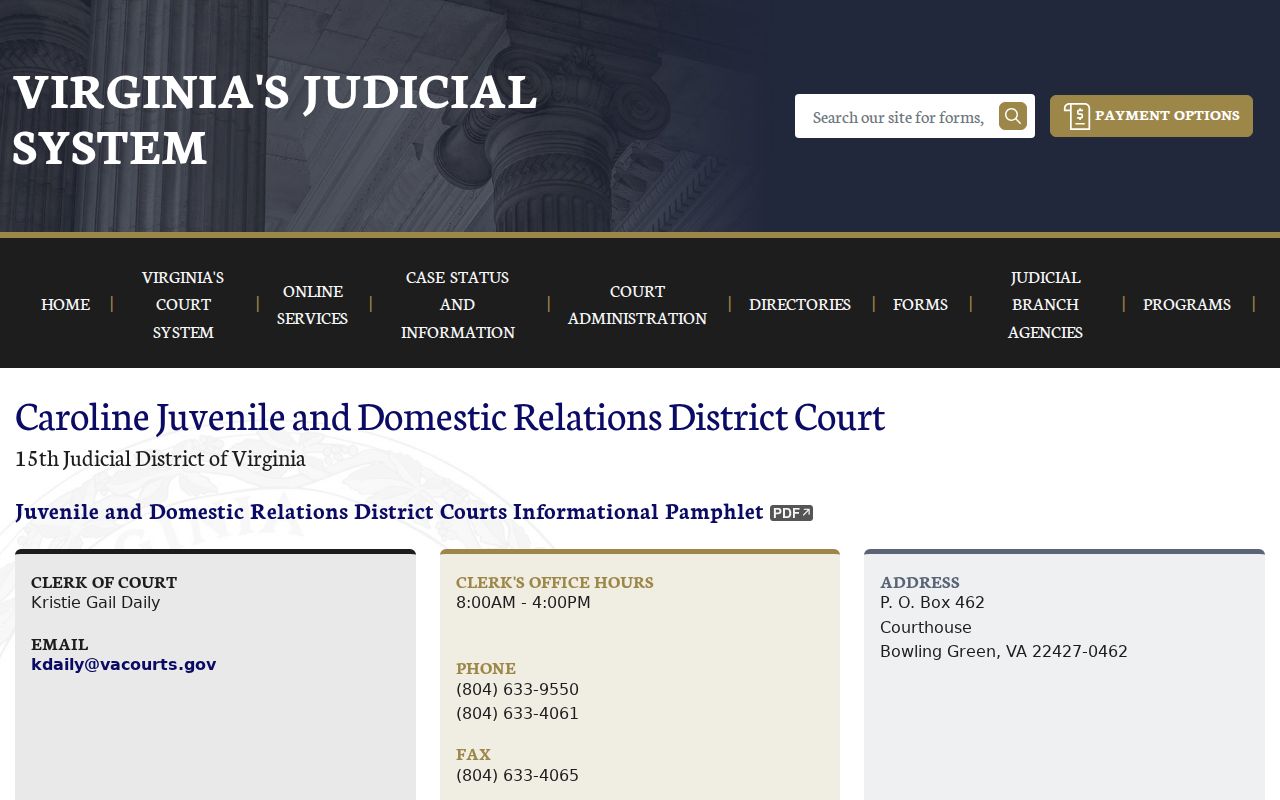
The absence of a juvenile result from OCIS reflects the access rule, not proof that no proceeding exists.
Criminal Case Stages in Caroline County
A Caroline County felony often starts with a warrant, summons, or arrest and a magistrate review. General District then handles the preliminary stage unless that hearing is waived or the charge is directly indicted. Certification or a grand-jury true bill moves the prosecution to Circuit Court. There, arraignment, motions, plea or trial, disposition, and sentencing appear as distinct docket events. A misdemeanor usually remains in General District. If appealed, it proceeds to Circuit for a new hearing.
Case flow: Charges Filed › Arraignment › Pretrial › Plea or Trial › Disposition › Sentencing
The Virginia Judiciary online-services index shows the available routes for finding those events.
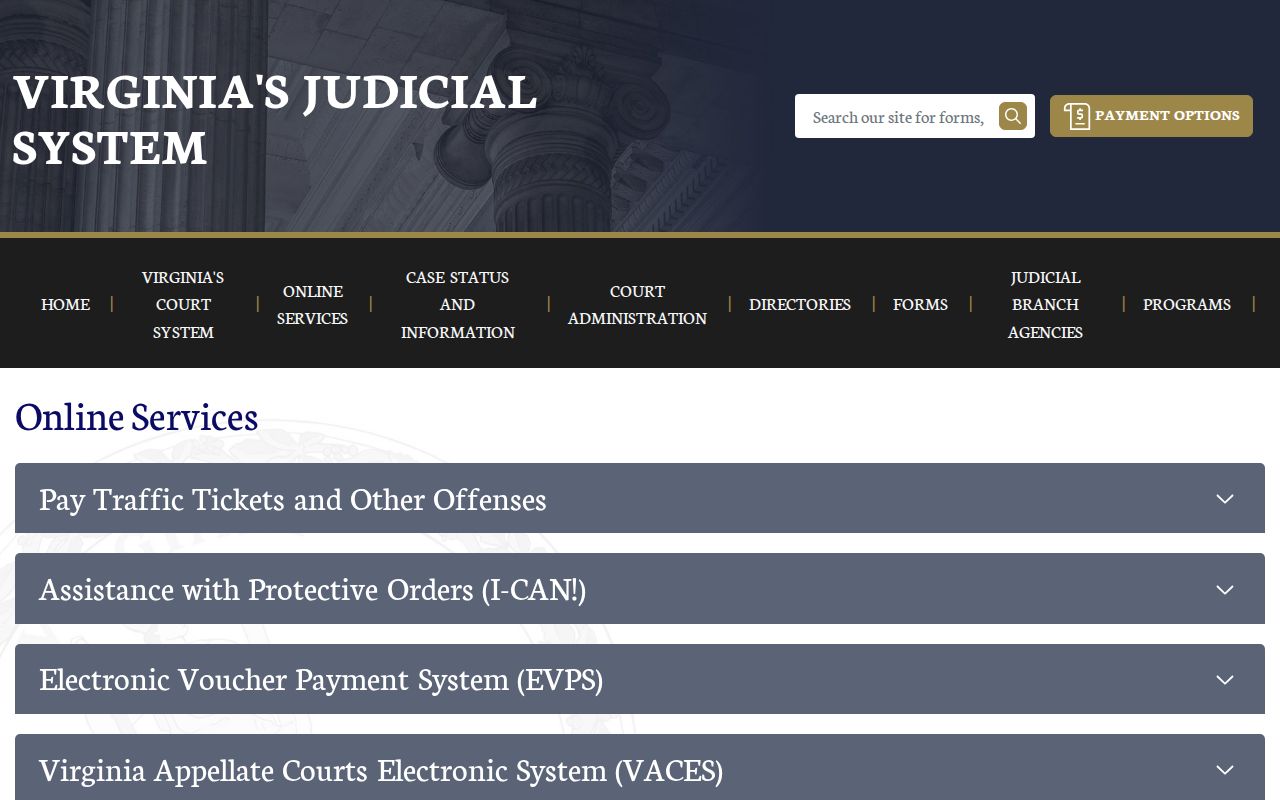
Track the case number and court at every stage because the same prosecution may leave entries in two Caroline County courts.
Caroline County Case Terms
Virginia docket terms can hide the plain result of a Caroline County charge. Read the disposition field with the plea and sentence rather than guessing from one word. These terms appear often in court files:
- Disposition
- The outcome of a charge, such as conviction, dismissal, acquittal, or nolle prosequi.
- Nolle prosequi
- A prosecutor's decision, accepted by the court, not to proceed on that charge at that time.
- Indictment
- A formal felony accusation returned by a grand jury. It is not proof of guilt.
- Capias
- Court process that commands arrest, often after a failure to appear or comply.
- Suspended time
- Part of a sentence not served at once, subject to the court's stated conditions.
A charge may be amended, dismissed, or replaced. The final order from the Caroline County clerk is stronger proof of what the court did than the first charge text.
Caroline County Certified Case Records
The Circuit Clerk's public counter is at 112 Courthouse Lane, Suite A, Bowling Green, VA 22427. Its mailing address is P.O. Box 309, Bowling Green, VA 22427-0309. The office phone is 804-633-5800, and listed hours are 8:30 a.m. to 4:00 p.m. Ask for the precise item, such as a sentencing order, disposition, indictment, or certified copy. General District requests should go to that clerk at 804-633-5720. Calling first can prevent a trip to the wrong Caroline County counter.
Caroline Circuit Court Clerk
112 Courthouse Lane, Suite A
Bowling Green, VA 22427
804-633-5800
Monday through Friday, 8:30 a.m. to 4:00 p.m.
Caroline General District Court
Bowling Green courthouse complex
804-633-5720
Call for the current counter schedule and copy process.
Note: Confirm the Caroline County copy and certification fee before ordering because no current local criminal-copy amount was published.
Access Rules for Case Records
Public access does not make every Caroline County case detail open. Virginia court-record access law governs clerk copies, while judicial rules and specific confidentiality laws also apply. Juvenile case information, sealed records, victim and minor identifiers, Social Security numbers, medical details, and some active or security-sensitive material can be withheld or redacted. An online result may show less than the clerk's file, yet a paper file can also contain protected pages that the clerk cannot release.
Virginia access rule: Virginia Code § 17.1-208 governs access and copies from clerks, subject to other law and court rules.
If a Caroline County record should have been sealed or has a wrong disposition, first obtain the court's certified outcome. Then contact the reporting clerk or arresting agency. Virginia law also gives a person a process to inspect and challenge qualifying criminal-history data. A public docket search cannot replace that correction process.